On February 20, the U.S. Supreme Court issued a historic 6-3 ruling that blocked the administration from using the International Emergency Economic Powers Act (IEEPA) to enforce broad import tariffs.
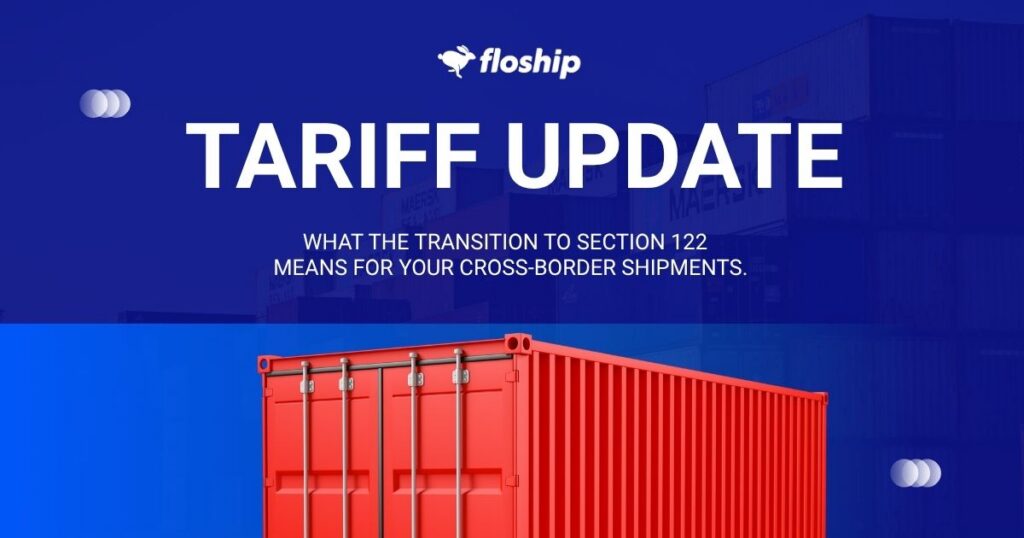
Within hours, the White House pivoted. They rolled out a new global tariff under Section 122 of the Trade Act of 1974 and signed a parallel Executive Order to make sure the duty-free de minimis suspension stayed firmly in place.
Rapid policy shifts are frustrating, but panic is not a strategy. Here is the reality of the new U.S. customs changes and exactly how the shift to Section 122 tariffs impacts cross-border e-commerce.
The End of IEEPA Tariffs
Because of the Supreme Court ruling, all duties previously collected under IEEPA have been canceled. This instantly drops the country-specific and reciprocal tariffs on imports from places like China, Mexico, Canada, and Brazil. (Note: Existing Section 232 tariffs on metals and Section 301 tariffs are unaffected and remain active.)
The New 10% Tariff (Section 122)
To replace the canceled IEEPA framework, the government is using the Trade Act of 1974 to roll out new temporary Section 122 tariffs on imported goods.
- The Timeline: This flat 10% tariff takes effect on February 24 at 12:01 a.m. EST and is currently set to last for 150 days.
- The Exemptions: According to the White House, several categories are exempt. This list primarily covers critical minerals, specific electronics, pharmaceuticals, aerospace products, and USMCA-compliant commercial goods.
The De Minimis Suspension is Locked In
For cross-border e-commerce brands, this is the most important update. A standalone Executive Order explicitly keeps the suspension of the duty-free de minimis threshold in place.
- This applies universally to all shipments, regardless of where they come from, their value, or how they shipped.
- As a result, international postal shipments will transition to the new 10% Section 122 tariff rate instead of the old IEEPA rates.
How Floship Handles Regulatory Shifts
You built your brand to create great products, not to spend your week decoding customs law.
At Floship, our fulfillment technology is built to adapt to regulatory changes instantly. Our software automatically calculates exact duty rates—including the new Section 122 tariffs—and manages all qualified party processing in the background. This ensures your cross-border shipments remain fully compliant and clear customs without any manual work or delays from your team.
The rules of global trade will keep changing, but your fulfillment speed shouldn’t have to.
Discover how Floship automates global compliance so you can scale internationally without the operational friction.
Who is Floship?
Floship is a leading global logistics technology company specializing in end-to-end, cross-border e-commerce fulfillment. We act as the operational backbone for fast-growing B2C and DTC brands by combining multi-origin warehousing with smart automation. Our mission is to simplify global trade, helping brands automate customs compliance, lower landed costs, and scale internationally without the operational friction.

Ready to Upgrade Your Logistics Solution?
Speak to a Floship e-commerce logistics consultant about improving your global supply chain today.