Global e-commerce trade in 2026 has reached a pivotal scale, with the U.S. market alone valued at $1.38 trillion (Mordor Intelligence, 2026). To maintain operational service levels amidst a slowing global economy and persistent trade tensions, businesses are shifting from reactive planning to real-time execution (UNCTAD, 2026).
Defining E-Commerce Logistics in 2026
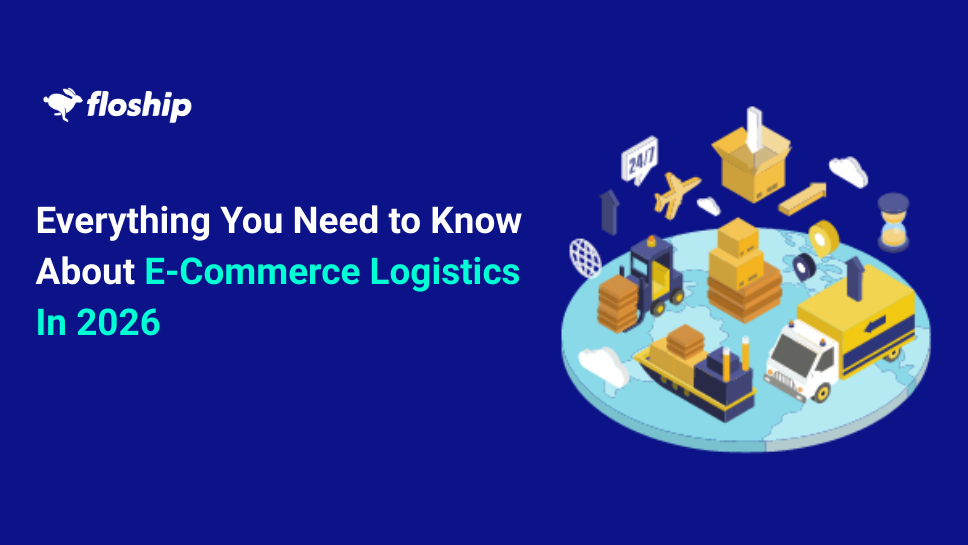
E-commerce logistics is the technical infrastructure required to manage the lifecycle of a product from purchase to final delivery. In 2026, this has evolved into “Integrated Digital Supply Chains,” where AI-driven systems automate the flow of goods to mitigate labor shortages and delivery cost inflation (Mordor Intelligence, 2026).
The Five Operational Components of Logistics Management
1. 3PL & 4PL Infrastructure
Fulfillment models are now categorized by their depth of digital integration:
- 3PL (Third-Party Logistics): Providers managing physical fulfillment, including labor and international shipping.
- 4PL (Fourth-Party Logistics): Strategic integrators that oversee multiple partners and technical resources on behalf of the merchant (Shopify, 2026). Floship provides a unified 4PL platform that consolidates these workflows into a single digital “Control Tower.”
2. Strategic Fulfillment Centers
Proximity to the end customer is the primary driver of cost management in 2026.
- North America: A three-node strategy (East, West, and Central) is now standard to offset rising domestic freight rates (Prologis, 2026).
- UK & EU: To navigate the July 1, 2026 EU Customs Reform—which introduces a €3 per-item customs duty on low-value goods—shippers are utilizing gateways like Lithuania to manage ocean-to-trucking transfers (SEKO, 2026).
- Hong Kong: Remains the premier tax-free hub for high-volume cross-border distribution in Southeast Asia.
3. Automated Logistics Management
Modern logistics relies on API-driven networks. Managing inventory across global sites requires a technical platform capable of real-time visibility. By 2026, over 70% of leading brands have shifted to automated inventory positioning, moving stock between locations before demand spikes occur(CLA, 2026).
4. Sorting and Technical Precision
Sorting facilities are the nodes where orders are categorized for transit. In 2026, technical optimization focuses on:
- Dimension Verification: Ensuring every parcel is measured to avoid carrier surcharges fordimensional weight.
- Packaging Specification: Utilizing sustainable, “custom-fit” packaging to reduce volumetric weight and total shipping expenditure.
5. Carrier and Last-Mile Integration
The final delivery is handled by the “carrier” (vessel or vehicle). In 2026, carrier selection is determined by a technical comparison of real-time rates, transit speed, and geospatial intelligence (FedEx, 2025) . The goal is to provide hyper-accurate delivery windows while bypassing urban “Green Zone” fees.
Technical Support and Compliance Oversight
Account management in 2026 involves tracking Supply Chain KPIs and sudden regulatory shifts. This includes monitoring the February 2026 U.S. Section 122 surcharge and the end of the €150 duty-free limit in Europe.
Finding an Operational Partner
Technical criteria for selecting a 2026 logistics provider include:
- Seamless Integration: Real-time connectivity between warehouse systems and e-commerce platforms.
- Global Hub Presence: Access to bonded warehouses and Foreign Trade Zones (FTZs).
- Landed-Cost Transparency: The ability to calculate duties and taxes at checkout to ensure a frictionless customer experience.
Conclusion
To lead in 2026, your fulfillment needs to be invisible to the customer and effortless for you. By partnering with a full-service provider like Floship, you can leverage a global warehouse network and a smart tech platform to ensure your brand remains competitive on a global scale.

Ready to Upgrade Your Logistics Solution?
Speak to a Floship e-commerce logistics consultant about improving your global supply chain today.